

| Colorado requires an ignition interlock for drivers who reinstate early after a DUI revocation and for certain high-risk drivers. First-time offenders typically keep the device for the full nine-month revocation, with early removal possible after four clean months. Drivers with a BAC of 0.15 or more, a test refusal, or repeat offenses face two years or longer. Violations can extend the restriction or lead to new charges. |
Written by the Law Offices of Steven J. Pisani, LLC, a Denver criminal and DUI defense firm. Reviewed by attorney Steven J. Pisani. Last reviewed October 2026. This article reflects C.R.S. 42-2-132.5 and House Bill 26-1242.
Ignition interlock requirements in Colorado depend on why your license was revoked, your blood alcohol level, and your record. For some drivers, the interlock is a choice that gets them back on the road early. For others, it is a mandatory condition that lasts for years.
We see clients every week who are unsure which rules apply to them. This guide focuses on the interlock itself: who needs one, how long, what the device requires day to day, and what happens when something goes wrong. For the bigger picture of how your license case runs alongside the criminal case, see our article on why a Denver DUI is two cases.
What Is an Ignition Interlock Device?
An ignition interlock is a breath testing device wired into your vehicle’s ignition. You blow into it before starting the car, and it will not allow the engine to start if it detects alcohol above the level set by the Colorado Department of Public Health and Environment.
The device also asks for random retests while you are driving. The device records every sample, missed test, and lockout, and the leasing company sends monthly reports to the Colorado Division of Motor Vehicles.
Who Must Have an Interlock in Colorado
Colorado law separates drivers into two groups. Some choose an interlock to reinstate early. Others must hold an interlock-restricted license before they can receive a regular license again.
| Situation | Interlock Requirement | Key Rule |
|---|---|---|
| First DUI or DUI per se, age 21 or older | Optional for early reinstatement | Restriction lasts for the remaining revocation period |
| Test refusal | Optional after two months of revocation | Persistent drunk driver rules apply |
| BAC of 0.15 or more | Mandatory after reinstatement | At least two years |
| Multiple DUI, DUI per se, or DWAI convictions | Mandatory after reinstatement | Two to five years |
| Habitual offender with a DUI-related revocation | Mandatory after reinstatement | At least one year |
| Revocation for interlock circumvention | Mandatory after reinstatement | At least one year |
| Driver under 21 at the time of the offense | Early reinstatement only after one year | Restriction follows the offense type |
The difference between a DUI and a DWAI matters here, because the revocation that triggers interlock rules usually follows a DUI or DUI per se conviction. Our guide to DUI vs. DWAI in Colorado explains how the two charges differ.
How Long the Interlock Stays in Your Car
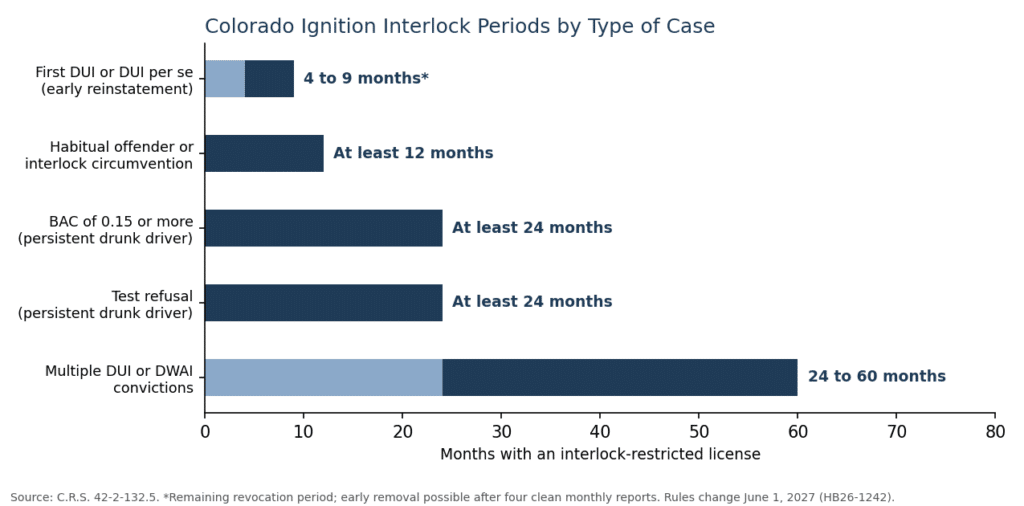
The required period depends on your category. The chart below shows the minimum time you must keep an interlock-restricted license for the most common situations.
The Persistent Drunk Driver Designation
Colorado labels some drivers as persistent drunk drivers, including those with a BAC of 0.15 or more and those who refuse chemical testing. A persistent drunk driver must hold an interlock-restricted license for at least two years after reinstatement. Early removal is not available, no matter how clean the monthly reports are.
Early Removal for First-Time Offenders
A first-time offender who reinstates early can become eligible for an unrestricted license once four consecutive monthly reports show that the device never prevented the car from starting because of breath alcohol, and that there was no tampering or circumvention. If you believe you qualify and have not received notice from the DMV, you can request a hearing on eligibility.
What the Law Requires Before the DMV Issues the License
Getting an interlock-restricted license involves more than installing a device. Before the DMV will issue one, you generally need to:
- Sign a lease with an approved provider for a device in every vehicle registered in your name and any other vehicle you plan to drive.
- Obtain written consent from any co-owner of each vehicle with a device installed.
- File proof of financial responsibility, usually an SR-22, and keep it for the longer of three years or the restriction period.
- Satisfy any other reinstatement conditions, including waiting periods for unrelated restraints.
If you do not own a car and have no access to one, Colorado allows a non-owner affidavit in some situations. If you later get access to a vehicle, you must install a device for the rest of the restriction.
Day-to-Day Rules While the Device Is Installed
Monitoring and Service Visits
The provider must check the device at least once every 60 days and report any tampering to the DMV within five days. Missed service appointments and lease terminations create their own problems. If your lease ends before the restriction does and you do not sign a new one, the DMV will suspend your license until you do.
Lockouts and Extensions
A single failed breath test is not the end of the road. However, if the device prevents normal operation because of excessive breath alcohol in three of any 12 consecutive monthly reporting periods, the DMV extends the restriction by an additional 12 months. You have the right to a hearing, and a hearing officer can sustain, reduce, or rescind the extension based on the circumstances.
Commercial Drivers
An interlock-restricted license cannot authorize driving a commercial motor vehicle during the restriction. For drivers who earn a living behind the wheel, that limitation often matters more than the device itself.
| WORRIED ABOUT YOUR LICENSE AFTER A DUI ARREST?
The choices you make in the first few weeks, including whether to request a DMV hearing or reinstate early, affect how long an interlock stays in your life. Attorney Pisani personally reviews every case. Recent result: DUI 2nd offense, dismissed (Denver, CO). Past results do not guarantee a similar outcome. Call (303) 635-6768 for a free consultation. |
Violations That Can Lead to New Charges
Colorado treats interlock violations as more than paperwork problems. The consequences fall into two tiers.
- Driving without an interlock or circumventing one. Operating a vehicle without an approved device, or trying to bypass it, is a class 1 traffic misdemeanor. The officer will confiscate your license on the spot, and the DMV revokes the restricted license for one year or the remaining restraint period, whichever is longer.
- Tampering. Bypassing or interfering with a device, or helping someone else do it, is a class 2 misdemeanor. Knowingly driving a car with a tampered device is also a violation.
The most common ways drivers end up facing these charges are having someone else blow into the device, disconnecting it, or borrowing a friend’s car. A circumvention revocation also triggers its own mandatory interlock period when you eventually reinstate.
What an Interlock Costs and Who Can Get Help
Drivers pay for installation, monthly leasing, calibration visits, and removal. Colorado already operates a financial assistance program for first-time offenders and persistent drunk drivers who cannot afford the full cost, funded through the state’s first-time drunk driving offender account.
Changes Coming June 1, 2027
House Bill 26-1242, signed on May 28, 2026, changes the rules for revocations on or after June 1, 2027. The two biggest changes are:
- A nine-month minimum for first offenses. Drivers revoked for a first DUI, DUI per se, or excess BAC of 0.08 must keep an interlock-restricted license for nine consecutive months after reinstatement, unless they qualify for early removal.
- Expanded financial help. Eligible participants, including those enrolled in public assistance or earning no more than 150 percent of the federal poverty level, will receive free standard installation, free removal, and up to a 50 percent discount on monthly lease costs.
If your arrest happened recently, the timing of your revocation could determine which set of rules applies to you.
Before You Remove the Device
Your interlock-restricted license is issued to expire 20 days after the interlock requirement ends. The DMV advises applying for a non-restricted license before removing the device. Removing it first can leave you driving without a valid license, which creates a new problem just as the old one ends.
Frequently Asked Questions About Colorado Ignition Interlock Requirements
Do I need an ignition interlock after a first DUI in Colorado?
Only if you want to drive before your nine-month revocation ends. Under current law, a first-time offender age 21 or older can reinstate early with an interlock-restricted license at any time. For first-offense revocations on or after June 1, 2027, the law requires nine consecutive months with an interlock after reinstatement, unless you qualify for early removal.
How long do I have to keep an interlock after a third DUI in Colorado?
A person whose license was revoked for multiple DUI, DUI per se, or DWAI convictions must hold an interlock-restricted license for at least two years and up to five years after reinstatement. Persistent drunk driver status also carries a two-year minimum.
Does refusing a breath or blood test mean I need an interlock?
In most cases, yes. A refusal brings a one-year revocation and a persistent drunk driver designation. You can apply for early reinstatement with an interlock after two months of revocation, but persistent drunk drivers must keep the device for at least two years.
Can I get the interlock removed early in Colorado?
First-time offenders can become eligible for an unrestricted license after four consecutive monthly reports show no high-BAC lockouts, tampering, or circumvention. Early removal is not available for persistent drunk drivers.
Can I drive a work vehicle without an interlock?
Generally, no. An interlock-restricted license allows you to drive only vehicles with an approved device installed, and it does not authorize operation of a commercial motor vehicle during the restriction.
What happens if my interlock records a failed breath test?
A single lockout does not automatically end your restriction, but three lockouts for excessive breath alcohol in any 12 consecutive monthly reporting periods extend the restriction by 12 months. You are entitled to a hearing on that extension.
What Happens When You Call Our Office
When you call (303) 635-6768, we will ask when you were arrested, whether you took or refused a test, your BAC if you know it, and whether you have any prior alcohol-related offenses. Attorney Pisani will review your situation in a free consultation and explain whether an interlock is required, optional, or avoidable, how long it may last, and what deadlines you are facing right now.
Talk to a Denver DUI Defense Lawyer About Your License
An ignition interlock can keep you working and driving, but only if you understand the rules that come with it. Our Denver DUI defense practice handles both the criminal case and the license side, and our DMV assistance services help drivers through hearings and reinstatement. For broader context on enforcement across the state, see our breakdown of Colorado DUI statistics.
Call the Law Offices of Steven J. Pisani, LLC at (303) 635-6768 for a free consultation. 600 17th Street, Unit 2823, Denver, CO 80202.