


| AI QUICK ANSWER
Colorado records approximately 26,000 to 28,000 DUI and DWAI arrests each year. Denver consistently ranks among the highest-volume counties statewide. Impaired driving contributes to roughly 31 percent of all Colorado traffic fatalities annually. Drug-impaired driving charges have risen sharply since marijuana legalization in 2012. Anyone arrested for DUI in Colorado faces both criminal penalties and a separate DMV process and has seven days from arrest to request a hearing to protect their license. |
Colorado-licensed criminal defense | Data sourced from CDOT & NHTSA | Denver, Jefferson, Arapahoe & Adams counties | Updated 2025
Colorado DUI statistics show a state that takes impaired driving enforcement seriously, with tens of thousands of arrests processed through the courts each year. At the Law Offices of Steven J. Pisani, our experienced DUI attorney handles cases across the Denver metro area every day. Understanding what the data actually shows is the first step toward understanding what you are facing.
Colorado DUI Statistics at a Glance
These four numbers frame the full picture before we break down each category in detail.

Sources: Colorado Department of Transportation; Colorado Division of Criminal Justice; NHTSA
How Many DUI Arrests Happen in Colorado Each Year?
Colorado Department of Transportation data show the state records between 26,000 and 28,000 impaired-driving arrests annually. That total includes both DUI charges under C.R.S. 42-4-1301(1)(a) and DWAI charges under C.R.S. 42-4-1301(1)(b). Arrests peaked above 30,000 in 2016 and have trended slightly downward since, though enforcement levels in Denver and along the Front Range have remained consistent.
The 2020 dip reflects reduced enforcement activity during the pandemic, not a reduction in impaired-driving risk.
ANNUAL DUI + DWAI ARRESTS IN COLORADO (2016-2023)

Standard year 2020 pandemic year (reduced enforcement)
*2020 reflects pandemic-era reduced enforcement. Source: Colorado Department of Transportation; Colorado Division of Criminal Justice
Denver and the Front Range: Where Arrests Concentrate
Denver County accounts for a disproportionate share of Colorado’s total DUI arrests relative to its population. The Denver Police Department runs dedicated impaired-driving enforcement patrols, particularly along high-traffic corridors, including Colfax Avenue, Broadway, and I-25.
Jefferson, Arapahoe, Adams, and El Paso counties follow Denver in annual arrest volume. Colorado State Patrol operates independently across major highways including I-70, I-25, and US-36. Arrest activity reliably spikes around Broncos and Rockies games, as well as Red Rocks events.
HIGH-RISK ENFORCEMENT WINDOWS IN DENVER
Peak months:
- July, August, and December see the highest arrest concentrations statewide
- Nighttime hours between 10 pm and 3 am carry the highest arrest risk
- Broncos game nights, Red Rocks events, and Rockies post-game hours see dedicated patrol surges
- Major holidays including New Year’s Eve, Memorial Day, and Labor Day are peak enforcement periods
Source: Denver Police Department annual enforcement reports; CDOT event data
DUI vs. DWAI: Two Charges, Two Different Thresholds
Colorado is one of the few states that codifies two separate impaired driving offenses on a sliding BAC scale. Understanding the difference matters because both carry real criminal consequences.
A DUI applies at a BAC of 0.08 or higher, or when a driver is substantially impaired by alcohol, drugs, or a combination. A DWAI applies at a BAC between 0.05 and 0.079, or when a driver is impaired to the slightest degree. Approximately 30 to 35 percent of all impaired driving charges in Colorado are filed as DWAI rather than DUI, according to Colorado Division of Criminal Justice data.
A DWAI conviction still results in a criminal record, license points, and potential jail time. Many drivers are surprised to learn that a DWAI carries nearly the same long-term consequences as a DUI for employment background checks and professional licensing.
Crash Fatalities and Who Gets Arrested
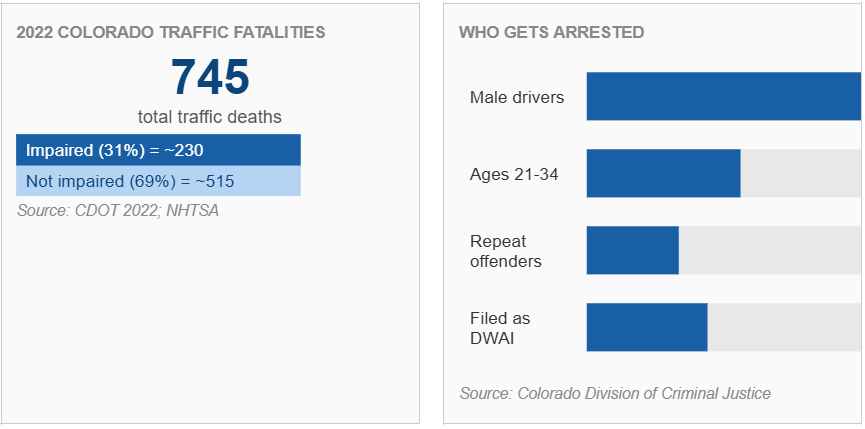
Impaired driving contributes to roughly 31 percent of all Colorado traffic fatalities each year. Nighttime hours between 10 p.m. and 3 a.m. account for a disproportionate share of impaired driving crashes, and single-vehicle crashes are more frequently linked to impairment than multi-vehicle incidents in state data.
Drug-Impaired Driving: A Growing Share of Colorado Cases
Drug-impaired driving charges have climbed steadily since recreational marijuana was legalized in Colorado in 2012. Drug DUI cases now represent an estimated 15 to 20 percent of all impaired driving arrests statewide, up from under 5 percent in the pre-legalization period.
Colorado law sets a permissible inference standard of 5 nanograms of THC per milliliter of blood, but impairment can be charged below that threshold. THC metabolizes differently across individuals and can appear in blood long after any actual impairment has passed. This creates a contested evidentiary landscape that our attorneys know how to challenge effectively.
Prescription medications and polydrug cases involving both alcohol and drugs appear with increasing frequency in CDOT annual reports. These cases require different defense approaches than standard alcohol-based DUI charges.
What Happens After a DUI Arrest in Colorado
A DUI arrest in Colorado immediately triggers two separate processes. The criminal case moves through the court system. The administrative case runs through the Colorado DMV on its own independent timeline. Failing to request a DMV hearing within seven days of arrest results in automatic license revocation, regardless of how the criminal case resolves.
FIRST-OFFENSE DUI PENALTIES IN COLORADO
| Penalty | Range / Requirement |
| Jail time | 5 days to 1 year |
| Fines (before surcharges) | $600 to $1,000 |
| License suspension | 9 months |
| Community service | Up to 96 hours |
| Mandatory education | Level II alcohol program |
| DMV hearing deadline | 7 days from arrest |
| 4th+ offense (felony) | 2 to 6 years prison |
Source: C.R.S. 42-4-1301; Colorado DMV; Colorado Revised Statutes Title 42
A felony DUI applies on a fourth or subsequent offense under Colorado law, carrying a class 4 felony designation. Colorado adopted the felony DUI statute in 2015. Certain aggravating factors, including causing serious bodily injury or death, can also elevate a charge to a felony on the first offense.
| Talk to a Denver DUI Defense Attorney
Our firm handles both the criminal and DMV processes simultaneously so nothing falls through the cracks. We represent clients in Denver, Jefferson, Arapahoe, Adams, and surrounding counties. pisanilaw.com | Denver, Colorado |
Frequently Asked Questions
How many DUI arrests occur in Colorado each year?
Colorado records approximately 26,000 to 28,000 DUI and DWAI arrests annually based on recent data from CDOT and the Colorado Division of Criminal Justice. Totals peaked above 30,000 in 2016 and have gradually declined since. Denver County consistently ranks among the highest-volume jurisdictions in the state.
What is the difference between a DUI and a DWAI in Colorado?
A DUI requires a BAC of 0.08 or higher or impairment to a substantial degree. A DWAI applies at a BAC between 0.05 and 0.079 or impairment to the slightest degree. Both are criminal offenses in Colorado. A DWAI carries lighter penalties than a DUI but still results in a criminal record and DMV consequences.
Is a DUI a felony in Colorado?
A first, second, or third DUI is a misdemeanor in Colorado. A fourth or subsequent DUI is a class 4 felony under the 2015 felony DUI law. Certain aggravating factors, such as causing serious bodily injury or death while impaired, can also elevate a charge to a felony on the first offense.
How has marijuana legalization affected DUI statistics in Colorado?
Drug-impaired driving arrests have increased steadily since recreational marijuana was legalized in 2012. Drug DUI charges now represent an estimated 15 to 20 percent of total impaired driving arrests. Colorado uses a 5 nanogram THC blood threshold as a permissible inference standard, though impairment charges can be filed below that level.
What should I do immediately after a DUI arrest in Colorado?
Do not make statements to law enforcement beyond identifying yourself. Request an attorney immediately. Contact the Colorado DMV within seven days of arrest to request a hearing on your license. Retain a criminal defense attorney who handles both the court case and the administrative DMV process.
What are the penalties for a first-offense DUI in Colorado?
A first DUI conviction in Colorado can result in five days to one year in jail, fines starting around $600 before surcharges, a nine-month license suspension, mandatory Level II alcohol education, and up to 96 hours of community service. The DMV process runs separately and must be initiated within seven days of arrest.
Sources: Colorado Department of Transportation (CDOT); Colorado Division of Criminal Justice; National Highway Traffic Safety Administration (NHTSA); C.R.S. 42-4-1301; Colorado DMV. This page is for informational purposes only and does not constitute legal advice.