

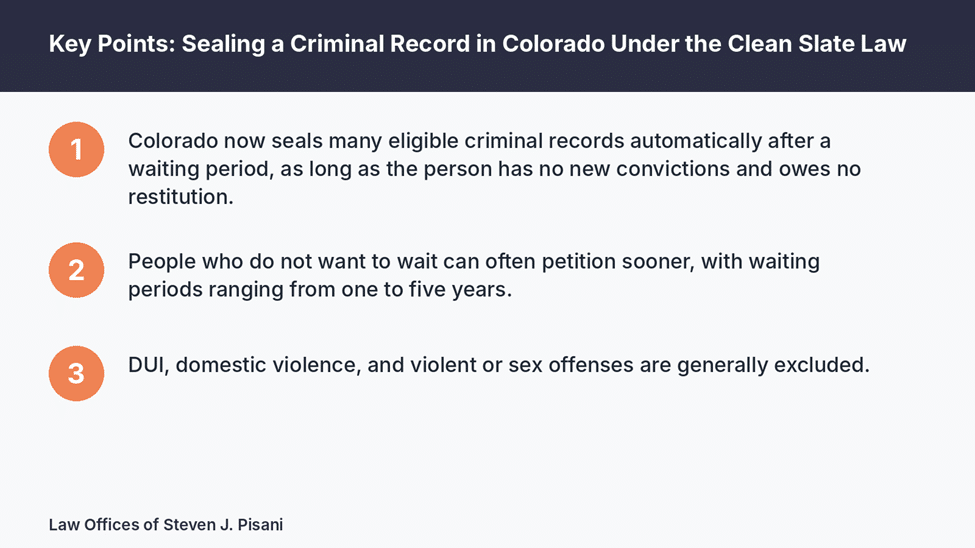
Colorado now seals many eligible criminal records automatically after a waiting period, as long as the person has no new convictions and owes no restitution. People who do not want to wait can often petition sooner, with waiting periods ranging from one to five years. DUI, domestic violence, and violent or sex offenses are generally excluded.
Reviewed by Steven J. Pisani, attorney at the Law Offices of Steven J. Pisani. Last reviewed November 2026.
A criminal record can follow a person for years, showing up in background checks for jobs, apartments, and professional licenses long after the case is over. Colorado has expanded record relief in recent years through its Clean Slate laws, passed in 2022 and expanded in 2024. Many people with older convictions in Denver and across the Front Range may now qualify for sealing, sometimes without filing anything.
Here is how the system works and how to tell whether your record may qualify.
What Sealing Does
Sealing removes a record from public view. Once sealed, most employers, landlords, and members of the public cannot see the case, and you can generally answer as though the case never happened when asked on applications. Sealed records remain available to courts, prosecutors, law enforcement, and certain agencies that conduct specialized background checks. Sealing does not vacate the conviction and is not a pardon.
Automatic Sealing Under the Clean Slate Laws
Senate Bill 22-099 and House Bill 24-1133 created automatic sealing for many convictions. The State Court Administrator compiles eligible cases each quarter, and district attorneys have a short period to object. Automatic sealing of misdemeanor and petty offense records began in 2024, and felonies were added starting July 1, 2025. Dismissed cases, acquittals, and completed deferred judgments and diversions can also be sealed automatically.
Waiting Periods for Automatic Sealing
- Civil infractions: 4 years
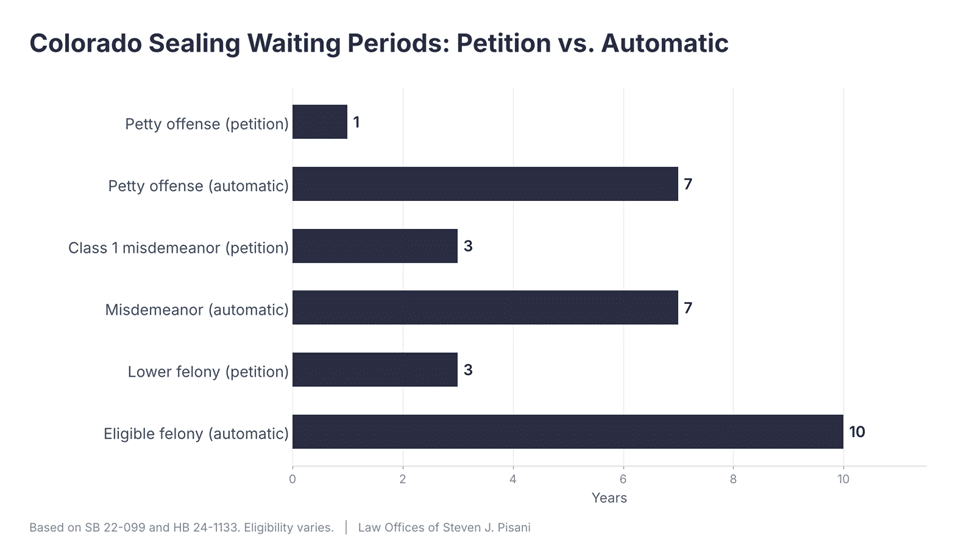
- Petty offenses and misdemeanors: 7 years
- Eligible felonies: 10 years
Waiting periods generally run from final disposition, or for felonies from the later of disposition or release from supervision. You must have no new convictions during that time and no outstanding restitution.
Petition-Based Sealing Moves Faster
If you do not want to wait for automatic sealing, you may be able to file a petition. Petition waiting periods are shorter:
- Civil infractions and petty offenses: 1 year
- Class 2 and 3 misdemeanors and drug misdemeanors: 2 years
- Class 1 misdemeanors and many lower-level felonies: 3 years
- Other eligible offenses: 5 years
The court may hold a hearing and weigh your privacy interests against the public’s interest in access.
How to File a Petition to Seal Records
The petition process generally follows these steps:
- Gather the case number, charges, and final disposition for each case you want sealed, along with proof that fines and restitution are paid
- Get your Colorado Bureau of Investigation criminal history to confirm what appears on your record
- Complete the correct petition form for the type of case, since forms differ for convictions, dismissals, and drug offenses
- File the petition in the court where the case was handled and pay the filing fee unless it is waived
- Serve the district attorney, who may object or ask for a hearing
- Attend any hearing and be ready to explain how sealing would help with work, housing, or education
If the court denies the petition, ask why. Some denials can be fixed by paying remaining restitution or waiting until the full period has passed, and a later petition may be possible.
Offenses That Usually Cannot Be Sealed
- DUI and most traffic offenses
- Domestic violence offenses
- Class 1, 2, and 3 felonies
- Violent and sexual offenses
- Child abuse offenses
Some otherwise ineligible misdemeanors may still be sealed in limited circumstances if the district attorney agrees or the person shows a significant need. Learn more about our misdemeanor defense practice.
How Objections Work
For automatic sealing, district attorneys can object on limited grounds, such as a pending case, an intervening conviction, or a plea agreement that barred sealing. For non-drug felonies, a prosecutor may also object on public safety grounds, which can lead to a hearing. Knowing whether an objection was filed matters if your record does not seal on schedule.
Checking Whether Your Record Was Sealed
Automatic sealing does not always happen without problems. Records may stay visible if restitution remains unpaid, if a court error occurred, or if the case was misclassified. You can request your court record and Colorado Bureau of Investigation history to confirm its status. If your record should have been sealed but wasn’t, a lawyer can help fix it.
Why Sealing Matters for Your Future
Sealing can open doors to jobs, housing, education, and licensing. It can also reduce the stress of explaining an old mistake. A new conviction after sealing can lead the court to unseal the earlier record, so staying out of trouble protects the relief.
The benefits often reach beyond paperwork. People with sealed records report less stress about background checks and more confidence applying for promotions, apartments, and volunteer roles. Steady work and stable housing support long-term financial security, and they make it easier to take part in community activities, such as coaching youth sports or volunteering at a child’s school, where background checks are common.
Getting Help With Record Sealing
Eligibility depends on the exact offense, the case outcome, the dates, and any later cases. An attorney can review your history, decide whether automatic sealing or a petition makes more sense, and handle filings and hearings. Learn more about our Denver criminal defense lawyer services.
Frequently Asked Questions
Does Colorado automatically seal criminal records?
Yes. Many eligible records are sealed automatically after a waiting period under the Clean Slate laws.
How long before a misdemeanor is sealed automatically in Colorado?
Generally, seven years with no new convictions and no outstanding restitution.
Can I seal a DUI in Colorado?
Generally no. DUI and most traffic offenses are excluded.
Can I petition to seal my record sooner?
Yes. Petition waiting periods are often one to five years.
Is sealing the same as expungement in Colorado?
No. Colorado uses sealing for adult records, while expungement mainly applies to juvenile records.
Will a sealed record show up on a background check?
Most private background checks will not show it, but certain agencies can still see it.
Does sealing my record restore my gun rights in Colorado?
Not by itself. Sealing hides the record from the public, but state and federal firearm restrictions may still apply to certain convictions. Talk to a lawyer about your specific case before assuming your rights are restored.
Talk to a Denver Criminal Defense Lawyer
The Law Offices of Steven J. Pisani help people in Denver and across the Front Range seal eligible records and move forward. When you call, our team will ask about your case history, dates, and any restitution, then explain whether automatic sealing or a petition is the better path. Learn more about our Denver criminal defense lawyer services.